

Six different calculations, one consistent answer.
New Orleans is a city unlike any other in America. We are home to 340,000 residents and host nearly 19 million visitors each year. We manage global events, complex infrastructure, major waterways, dense historic neighborhoods, and a service economy that never sleeps. And yet, our police staffing has fallen to levels not seen in decades.
The New Orleans Police Department (NOPD) is currently operating with roughly 900 sworn officers. For a city with our workload and responsibilities, that number is not sustainable. After reviewing almost every objective measure available (population ratios, calls for service, geography, history, and overtime costs) the conclusion is unmistakable:
New Orleans needs approximately 1,200 sworn officers. This is not a guesstimate, political, or aspirational number. It is the product of math.
Start With National Standards
Across the country, cities with populations above 250,000 average between 2.3 and 2.7 officers per 1,000 residents. Using a conservative 2.5 ratio:
350,000 residents ÷ 1,000 x 2.5 = 875 deployable officers.
But no department is 100% deployable. Officers are assigned to investigations, supervision, training, federal compliance, and specialty units. Others are on leave or restricted duty. Applying a standard operational multiplier of 1.4 brings the total required sworn strength to roughly 1,200 officers.
Then Adjust for Who We Actually Police
New Orleans does not serve just its residents.
With 19 million visitors annually, the city averages more than 50,000 additional people here every day and far more during peak events like Mardi Gras and the New Orleans Jazz & Heritage Festival.
That pushes our effective daily service population close to 400,000 people.
Using the same national ratios, the math again lands at approximately 1,200 officers.
The Workload Tells the Same Story
Perhaps the most revealing measure is calls for service. NOPD responds to roughly 400,000 – 450,000 calls annually. That includes emergency dispatches, priority incidents, and officer-initiated activity.
With 900 officers, that equates to roughly 450–500 calls per officer per year before accounting for report writing, investigations, court appearances, training, or consent decree requirements.
National workload standards suggest a sustainable level is closer to 300–350 calls per officer annually.
At 1,200 officers: 400,000 ÷ 1,200 = 333 calls per officer.
That is sustainable policing. That allows time for follow-up investigations. That allows proactive engagement. That reduces burnout.
Geography Matters, Too
New Orleans spans approximately 170 developed square miles requiring patrol coverage, along with waterways, interstates, port facilities, and historic districts.
Urban patrol standards commonly suggest 6–8 officers per square mile in high-demand environments. Using the midpoint produces a staffing need just under 1,200 officers.
Again, the math converges.
Look at Comparable Cities
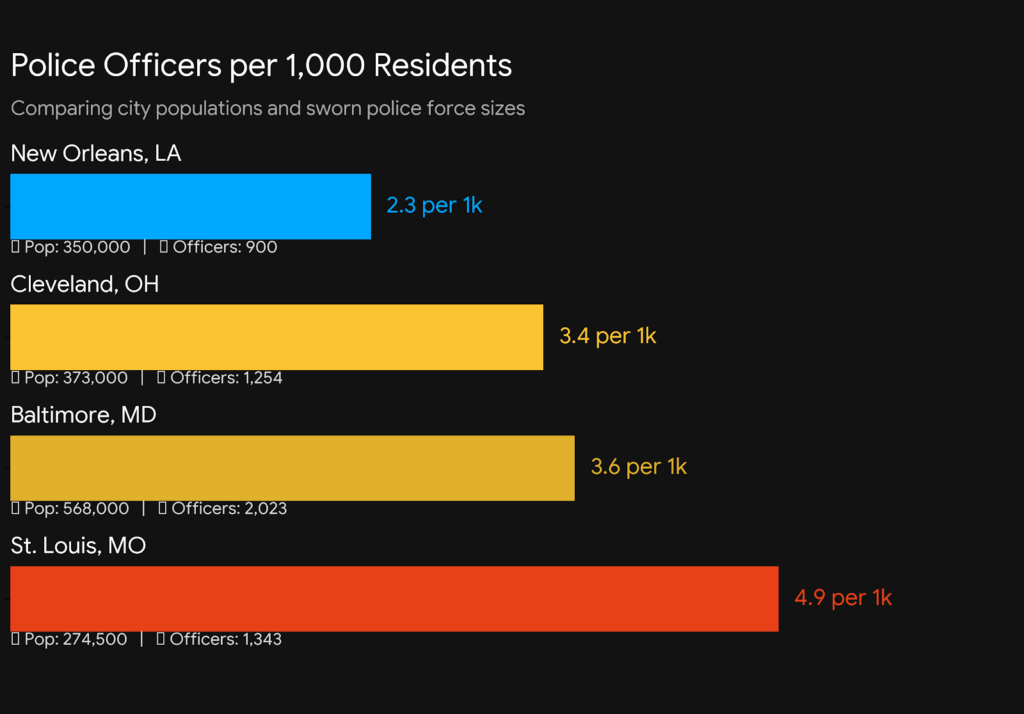
Cities facing similar crime and service demands staff at significantly higher levels.
- St. Louis, MO maintains around 4.9 officers per 1,000 residents.
- Baltimore, MD operates near 3.6 per 1,000.
- Cleveland, OH (the closest comparison in this category) utilizes 3.4 per 1,000.
Even at 1,200 officers (3.5 per 1,000), New Orleans would not be an outlier. It would simply be aligned with cities of comparable complexity.

The Financial Argument Is Just As Strong
Understaffing is expensive.
The City is fined around $214,000 each month ($2.5 Million/year) by the Municipal Police Employees’ Retirement System (MPERS) for losing a large percentage of NOPD officers in 2020-2021 and declaring the NOPD a “partially dissolved agency.” This fine has continued to compound despite current legal arguments and the precariousness of the situation certainly has an impact on recruiting and retention.
To compensate for low manpower, the City currently spends approximately $18-20 million annually in anticipated overtime. 2025 saw several “black swan” events that forced this number to around $50 million.
If roughly 300 additional officers were hired to bring the department to 1,200:
$18 million ÷ 300 = $60,000 per officer.
Each additional officer offsets approximately $60,000 per year in overtime costs alone – a figure that closely mirrors average salary levels. In practical terms, rebuilding staffing largely pays for itself while dramatically improving officer wellness and operational efficiency.
Burnout declines. Sick leave drops. Errors decrease. Response times improve.
History Confirms It
From the post–World War II era through the early 2000s, NOPD staffing consistently hovered between 1,100 and 1,600 officers. The current sub-1,000 staffing level is a historic anomaly, not a norm.
When adjusted for today’s population and service environment, the historical average aligns almost exactly with 1,200 officers.
This Is About Sustainability
Below 900 officers, policing becomes reactive. Investigations stall. Community engagement shrinks. Overtime balloons. Officers burn out.
At 1,200 officers, the department can:
- Staff patrol districts consistently
- Support specialized investigative units
- Cover major events without stripping neighborhoods
- Reduce delayed responses
- Maintain compliance with federal standards
- Expand community engagement initiatives
- Operate within a fiscally responsible overtime structure
The New Orleans Police and Justice Foundation supports rebuilding the department to 1,200 sworn officers because every responsible analytical method points to that number.
Population math supports it.
Tourism math supports it.
Geographic math supports it.
Workload math supports it.
Historical precedent supports it.
Financial analysis supports it.
When six different calculations lead to the same conclusion, that conclusion deserves serious attention.
New Orleans is a world-class city. It deserves a police force sized to meet its real-world demands – not one stretched to its breaking point. Can civilian personnel or technology like drones offset the staffing? Possibly, but that requires a significant investment and substantial change in how the community utilizes their police department. For now, “doing more with less,” is simply not an option.
The math is clear. New Orleans needs 1,200 officers.