
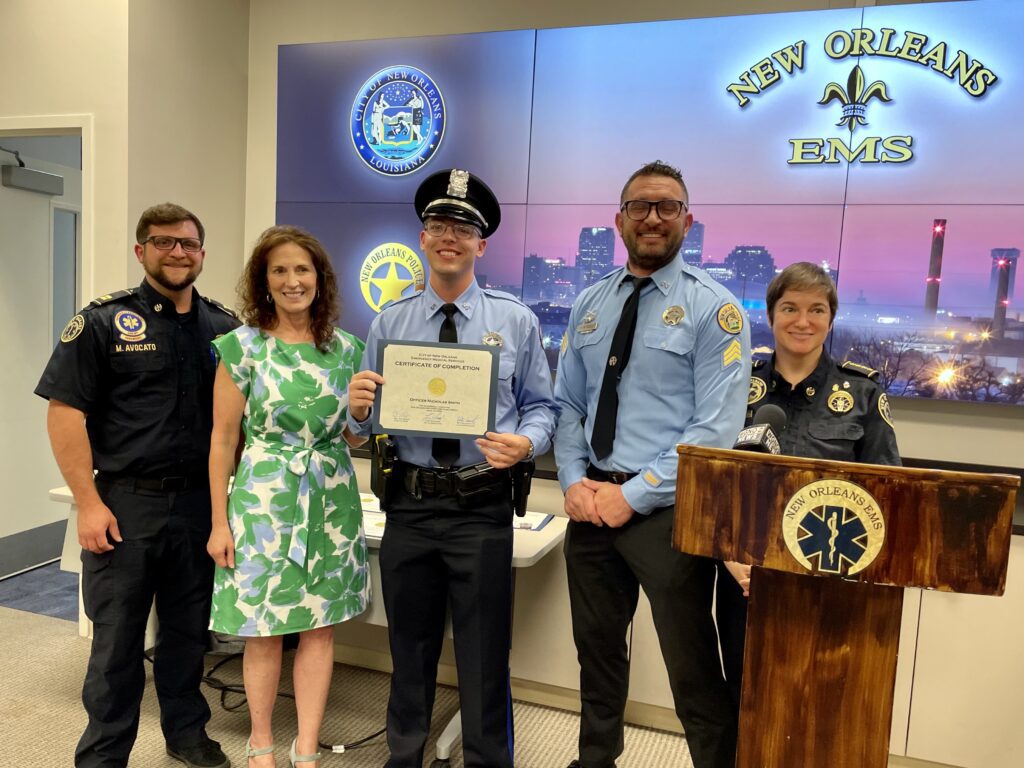
 In New Orleans, when every second counts, the difference between life and death isn’t just how fast an ambulance arrives – it’s whether someone on scene is trained and equipped to act before it does. That’s the motivation behind the EMR (Emergency Medical Responder) Program that NOPJF helped launch in partnership with NOPD and the New Orleans Emergency Medical Services (NOEMS).
Why this program matters
NOEMS currently operates at roughly 70% of full staffing capacity. That staffing gap, combined with the city’s elevated rate of gunshot wounds, traumatic injuries and high-risk scenes, means patrol officers often arrive first – sometimes before EMS can safely enter. The EMR program equips those officers with medically-certified training and the tools to begin lifesaving care in those crucial moments. Thanks to a generous grant from Ochsner Health, 50 automated external defibrillators (AED’s) were also provided to the officers to be used during critical incidents. Police1
What we accomplished in 2024-2025
-
24 NOPD officers enrolled in the EMR certification program (a pilot collaboration with NOEMS).
-
Of those, 16 graduated and 8 are on-track to complete certification.
-
Each officer received 64 training hours, based on the nationally-recognized National Registry of Emergency Medical Technicians (NREMT) and the Louisiana Bureau of EMS (LBEMS) curriculum.
-
25 trauma response kits were assembled and issued to those officers (or those in training). Each kit includes: first aid supplies, trauma dressings, tourniquets, and portable automated external defibrillators (AEDs).
-
Data plans were activated for the portable AEDs donated by Ochsner Health, ensuring cardiac emergency care is available even in remote service areas.
-
8 NOPD districts now have at least one EMR-certified officer on at least one shift per day—establishing a foundation for a city-wide deployment strategy of one EMR officer per shift in each district.
-
50 quick-litter emergency transport stretchers have been scheduled for distribution to EMR officers, enhancing extraction and transport in the field.
-
500 mini first aid kits (M-FAKs) were assembled for patrol officers (belt-mounted trauma attachment kits designed for penetrating, blast or traumatic injury care before EMS arrival).
Real-world impact
The program isn’t just about numbers—it’s about lives saved.
-
In early 2025, a newly certified EMR officer used their training to save a gunshot victim by applying a chest seal and stabilizing the patient until paramedics arrived.
-
Across multiple other incidents involving traffic crashes, domestic violence or self-inflicted wounds, EMR officers rendered immediate care under unsafe conditions – care traditional EMS couldn’t provide until scene security was achieved.
-
The program has moved from pilot to permanence: under NOPD leadership, EMR certification is now a formal part of departmental training. (As reported by local media: “The Emergency Medical Responder program (EMR) … which has graduated eight officers in its inaugural class and provides life-saving services for victims who might not otherwise get quick attention from EMS responders due to unsafe scene conditions.”) WDSU
-
One of the first programs to publicly document the pairing of police EMT/EMR training and patrol car defibrillators: “Fifty new defibrillator devices to patrol cars … Fifty officers will undergo nine weeks of training to become certified as emergency medical responders… and qualified to use the new defibrillators.” Police1
Strengthened partnerships and recognition
Here’s a breakdown of what the program achieved:
A key moment came when NOEMS, NOPD and Ochsner Health announced a donation of 50 AEDs tied directly to this initiative. WDSU
The collaboration underscores a shift in New Orleans: not just policing, not just EMS – but a united front to save lives sooner.
By equipping officers with medical training and gear, we’re turning first-on-scene into first-care-on-scene.
Challenges and what’s next
No large-scale innovation is without its hurdles. Key areas include:
-
Program oversight: currently managed by Sgt. Andrew Packer (an EMT and NOPD supervisor) who also continues his district supervisory duties. Managing a growing EMR program while maintaining platoon responsibilities stretches resources.
-
Training capacity: A wait-list has already formed for future EMR classes, requiring expansion of instructor capacity, certification slots and equipment.
-
Sustainability and supply chain: Trauma kits, AEDs, M-FAKs and stretchers require ongoing restocking, maintenance, and budgeting.
-
Data tracking: While field interventions are recorded, establishing a formal real-time data management system shared between organizations (for tracking incidents, outcomes, equipment usage) remains a priority.
How the Impact 59 Grant fueled the expansion
The Impact 59 grant was a legacy program for Super Bowl LIX that awarded $3.5 million to 65 nonprofit organizations in the Greater New Orleans area. The grants were intended to create a lasting positive impact by funding projects in key areas like youth development, workforce training, education, health and wellness, and equity and inclusion. The program was a collaboration between the Super Bowl LIX Host Committee, Entergy, the NFL Foundation, the New Orleans Saints, Ochsner Health, Venture Global, and United Way of Southeast Louisiana. Thanks to the Impact 59 Grant:
-
The EMR program moved from vision to action – open to 24 officers in this period, with 16 graduating, 8 in progress.
-
Equipment acquisitions and distributions were funded: trauma kits, portable AEDs, data plans, M-FAKs and transport stretchers all trace back to grant-supported investment.
-
One EMR officer pursued and achieved EMT certification – deepening the Department’s medical capacity.
-
In short: Impact 59 accelerated training, expanded resources, and strengthened community safety in measurable ways.
Moving forward—beyond the grant
While the grant provided the jump-start, sustainability is already in motion:
-
NOPD and NOEMS are incorporating some elements of EMR training, deployment, and equipment into their operational budgets.
-
NOPJF continues to pursue private philanthropy, partnership grants and corporate support to maintain and expand the program – especially in high-priority, underserved neighborhoods.
-
The goal remains: one EMR-certified officer every shift, every district.
Why this matters for New Orleans
In a city that faces unique challenges – the high rate of violent injury, trauma scenes, resource limitations – training police officers to act as emergency medical responders is a smart, proven strategy. It means that when a call comes in, no one must wait for the “code 4” or the ambulance to be cleared for entry. An EMR-officer is already there – trained, equipped and ready.
This is public safety reinvented: speed, skill, equipment, collaboration.
We are proud of what we’ve achieved so far: 24 officers trained or training, 500 belt-mounted kits assembled, 25 trauma kits distributed, eight districts covered. But we’re just getting started. With your support, NOPJF, NOEMS, and NOPD will continue to turn seconds into saved lives, and make New Orleans safer for everyone.
Want to support the EMR program or learn more? Visit https://nopjf.org/donate/ or email Matthew@NOPJF.org


